 I’m continuing my blog series on why one should not interpret Genesis 1 in a literal fashion. I’ve mentioned the highly stylized nature of Genesis 1 (here), the internal coherence between having lights without light sources (here), and the fact that Adam is said to do too much on the sixth day (here). Another good reason to not interpret Genesis 1 in a literal fashion is because there exists literary incoherence between the first and second creation accounts. When one compares the two chapters with each other, it becomes readily obvious there are chronological, theological, and temporal differences between the two accounts. Most evangelicals typically hold to a one-event view when it comes to the earliest chapters of Genesis. The creation of the universe is found from Genesis 1:1-2:3 and then chapter 2:4-25 is an elaboration of what occurred during or on the sixth day. This harmonization of the two accounts is understandable. People may harmonize because of issues with inerrancy, the skepticism associated with Israel borrowing from other cultures, or because the two accounts may seemingly contradict. I do not think the two accounts stand in contradiction but in contradistinction- they are describing an event that happened in space-time history from different angles or viewpoints. This means there are multiple initial creation accounts but only one creation. In the ancient world, there was more than one version of how things started. The Israelites could have multiple accounts and not be upset or flustered. It is fitting to point out that we have the same thing within the Gospels. There are multiple accounts of many of the same events with different theological and literary points made and it does not bring inerrancy into question. The historical books of the OT also describe the same events from different viewpoints. Now on to the differences.
Bruce Waltke in his Old Testament Theology summarizes the sequential differences remarking:
If there is tension between day 1 and day 4 of the first creation account, there is an even greater tension in the temporal connections of the second creation (2:4-25) account with the first (1:1-2:3). The second creation account, as presented in the KJV, gives the following sequences of events: God fashions Adam, God plants the garden of Eden and the plants grow, God forms the animals. Adam names the animals, and God “builds” Eve. The NIV partially relieves the temporal tension by rendering the ambiguous narrative waw in 2:8 and 19 by pluperfects, “God had planted a garden” (2:8) and “had formed the animals” (2:19), allowing the sequence: planting the garden, forming the animals, naming the animals, and building Eve, a temporal sequence more harmonious with the first account. Nevertheless, even if one accepts this harmonizing rendering, the temporal burden involved in a straightforward reading of the two accounts is still unbearable. According to the first account, God made man and woman on the sixth day, and according to the second account, he made woman in the garden. Then, assuming the temporal harmony of the two accounts, God planted the garden before making Eve, and presumably he planted the garden on the third day along with other vegetation. But a straightforward reading of the second account envisions the trees as having sprouted and matured to the point of bearing fruit in three days. To be sure, creation may assume apparent age (“mature universe”), as when Christ turned water into wine as a sign and wonder that the new age had begun, but the text recounts that I AM “made all kinds of trees grow out of the ground (wayyasmah, Hiphil, 2:9) as a natural process with no indication that he intended it to create wonder.
Further differences within the two accounts can be seen below as the two accounts are paralleled with each other.
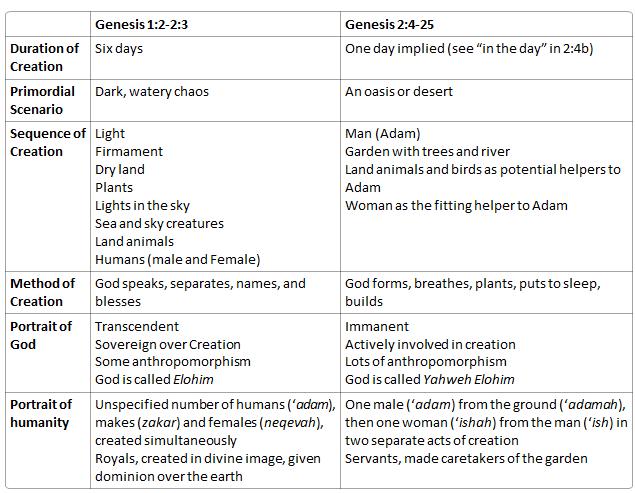
The theological portrait of the main character (God) is different within the two accounts. Genesis 1 presents a creation with no hint of battle or struggle. It came about by the Sovereign and powerful word of the Lord, a king’s decree if you will. God is announcing things to be within his temple as the supreme temple-builder or architect. This is not a king who says things and sometimes they happen. He speaks and it happens! All of creation is doing exactly what God says. In other creation accounts, many other gods would say something and nothing would come from it. This is not the portrait of God within the first account. There is no fight or questioning within the Gen. 1 narrative. This is a God who gets what he wants when he wants. He is not tame. He is a transcendent king who makes things come into existence. It is a picture of a God who is far off. Genesis 2 presents a potter in the dirt painstakingly creating his works. The second creation account presents God as one who is ever so near; he is immanent. The image is of someone deep down in the mud working (vv. 7-8, 22) as a potter works with the clay. It’s the image of God with dirt under his fingernails. God is said to lean down and breathe life down into the nostrils of Adam. That’s not the image of a king. It is a picture of a God who is near. The Bible starts with this tension and carries the motif to the very end. God is far off but so near. God commands and it is formed yet he is in the mud working with his own hands. God is completely different from us but yet we’re so much like him. There is good reason for including both these two accounts.
One possible objection would be the claim that in Matthew 19:4-5, Jesus referred to events in Genesis 1 and to events in Genesis 2 as one harmonious account. The Pharisees approach Jesus and attempt to trap him with a question concerned the ethics of divorce. During Jesus’ time, there was a significant debate between Pharisaical parties on the correct interpretation of Moses’ divorce regulations (Deut. 24:1), as noted in this excerpt from the Mishnah, 9.10: “The school of Shammai says: A man may not divorce his wife unless he has found unchastity in her. … And the school of Hillel says: [He may divorce her] even if she spoiled a dish for him. … Rabbi Akiba says, [he may divorce her] even if he found another fairer than she” (see Mishnah, 9 for an example of a Jewish certificate of divorce and the terms required for remarriage; see also Josephus, Jewish Antiquities 4.253 for the phrase “whatsoever cause”). The goal was to catch Jesus between a rock and a hard place. In response to their shyster, theological quandary, Jesus appeals to God’s intent in the institution of marriage found within Creation. Jesus avoids the Pharisaic argument about reasons for divorce and goes back to the beginning of creation to demonstrate God’s intention for the institution of marriage. It is to be a permanent bond between a man and a woman that joins them into one new union that is consecrated by physical intercourse. In his response, he quotes from both creation accounts as one event (Gen. 1:27 in Matt. 19:4 and Gen. 2:24 in Matt. 19:5-6). I do not think that this objection is very good though. Those who hold to a two creation accounts viewpoint agree that the Creation stories are both a narrative unity. The author or final compiler (s) included both stories as a narrative unity to expressly and adequately describe the majesty of the God of the Hebrews over the universe. This is how Jesus can refer to the Creation account and use inspired and authoritative words found within both descriptions of the one event.
For these reasons, it is likely best not to interpret Genesis 1 in a literalistic fashion.






 Austin's Blog
Leave a comment