Likewise the Spirit helps us in our weakness. For we do not know what to pray for as we ought, but the Spirit himself intercedes for us with groanings too deep for words. And he who searches hearts knows what is the mind of the Spirit, because the Spirit intercedes for the saints according to the will of God. (Romans 8:26-27)
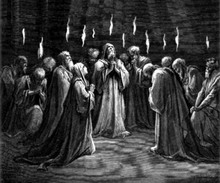 I was saved within the Holiness tradition before moving toward the Baptist denomination and heard this verse quoted often in adding validity to the ecstatic speech the church members were doing. The problem is that this passage (Romans 8) is not about spiritual gifts and, more specifically, it is not about speaking in tongues. The burden of the text is that the Spirit counterbalances the handicap of believers in prayer by interceding for them in accordance with God’s will. The hope of believers is also strengthened by the assistance of the Holy Spirit. Two scholars disagree on the passage and whether or not Paul encodes a statement about tongues. Is Romans 8:26-27 about tongues? Renowned New Testament scholar Gordon Fee argues in the affirmative for the following reasons: (1) the language corresponds with praying in/with the Spirit in other passages, (2) silent prayer was unheard of in the 1st century, (3) a reference to tongues explains how the Spirit groans and we groan as well, (4) the term ἀλαλήτοις may also mean that which is uttered is without words and would be ineffable, (5) groaning must involve audibility, (6) we cannot understand the content of the prayer yet the Spirit can, and (7) the only common experience in the early church that fits this experience is tongues.
 Arguing for the other side, New Testament scholar Thomas Schreiner disagrees for the following reasons: (1) Fee’s interpretation of what ἀλαλήτοις means is rather implausible, (2) στεναγμοῖς (the word for groaning) is probably not meant literally, and (3) the fact that all believers do not speak in tongues speaks against Fee’s interpretation. The groanings are the inexpressible longings that arise in every believer’s heart to do and know the will of God. Concerning point two, to find the gift of “tongues” because “groaning” is akin to what Charismatics and Pentecostals experience would require jumping through some interpretive loops. The idea of groaning within you is also found in the gospels where twice Jesus groaned within his spirit (John 11:33, 38). It is the experiential despair that creates the existential sigh within the soul of the righteous. Within the passage, there are three entities groaning: Creation, the believer and the Spirit. They’re all “groaning” because sin has affected Creation in such a way that pain, evil and disaster have befallen God’s good earth. The groaning of the Spirit no more has to be “tongues” within the passage anymore than the Creation’s groaning have to be that specific gift. Douglas Moo agrees with Schreiner remarking that “I take it that Paul is saying, then, that our failure to know God’s will and consequent inability to petition God specifically and assuredly is met by God’s Spirit, who himself expresses to God those intercessory petitions that perfectly match the will of God. When we do not know what to pray for—yes, even when we pray for things that are not best for us—we need not despair, for we can depend on the Spirit’s ministry of perfect intercession on our behalf.”
Schreiner’s last point is likely the most damaging to Fee’s interpretation. The Holy Spirit sovereignly gives spiritual gifts to His people and all of the gifts are equal (1 Cor. 12:4-11). He gives them for the edification of the body. 1 Corinthians 12:11 says that“All these (the gifts) are empowered by one and the same Spirit, who apportions to each one individually as he wills.” Believers do not all have the same gift or access to one specific gift. The apostle asks in verse 30 “Do all possess gifts of healing? Do all speak with tongues? Do all interpret?” The answer to the rhetorical question is no. This has bearing for how we interpret the Romans 8 passage. Why would Paul appeal to the experience of the gift of tongues to encourage believers that might not have that specific gift? Speaking in tongues is a phenomenon found within the early church (1 Cor. 12-14; Acts 2) but it is best to not see tongues within this specific pericope.






 Austin's Blog
Leave a comment