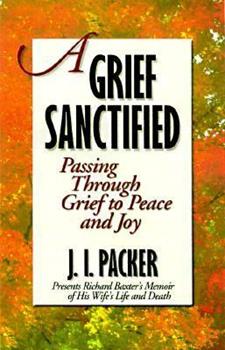

“All life, said the Puritans, must be managed in such a way that it is sanctified; that is, all activities must be performed, and all experiences received and responded to, in a way that honors God, benefits others as far as possible, and helps us forward in our knowledge and enjoyment of God here as we travel home to the glory of heaven hereafter. Of the experiences to be sanctified, some are pleasant and some are painful. The Puritan labels for the latter are “afflictions” and “crosses”; and bereavement, with the grief it brings, is one such.
How may an experience be sanctified? By relating it to the truth of the Gospel, so that we understand it in biblical and evangelical terms; by letting it remind us of truths we might otherwise forget or not take seriously; and by disciplining our hearts to accept it in an appropriate way—with gratitude or self-humbling or whatever.
Of what truths particularly should the bereavement experience remind us? Said the Puritans characteristically, the three that follow:
1. The reality of God’s sovereignty—that we, like everyone else, are always in his hands, and neither bereavement nor anything else occurs apart from his overruling will.
2. The reality of our own mortality—that we, like everyone else, are not in this world on a permanent basis and must sooner or later leave it for another mode of existence under other conditions.
3. The reality of heaven and hell—that we leave this world for one or the other, and that we should use the time God gives us here to ensure that as saved sinners we shall go to heaven, rather than as unsaved sinners go to hell.
To what exercises of mind and heart (attitudes and actions) should the bereavement experience lead us? Said the Puritans characteristically, these three:
1. The exercise of thanksgiving for all that we valued and enjoyed in the person we have lost and, in the case of a believer, for the happiness to which we know that he or she has now been promoted.
2. The exercise of submission to God, as we resign to him the loved one he has taken from us, confess to him that we had no claim on the continuance of that loved one’s earthly life, and consciously put ourselves in his hands for whatever future experiences he has in mind for us.
3. The exercise of patience, which is a compound of endurance and hope, as we live through our bereavement on a daily basis.
Grief—the experiential, emotional fruit of the bereavement event—is, as we have seen, a state of desolation and isolation, of alternating apathy and agony, of inner emptiness and exhaustion. How may such a condition be sanctified—that is, managed, lived with, and lived through in a way that honors God? No Puritan to my knowledge addresses the question in this form, but the Puritan answer would be this:

Starting from where you are, do what you can (it may not be much at first) to move toward the thanksgiving, submission, and patience of which we have just heard.
Do not let your grief loosen your grip on the goodness and grace of your loving Lord.
Cry (for there is nothing biblical or Christian, or indeed human, about the stiff upper lip).
Tell God your sadness (several of the psalms, though not written about bereavement, will supply words for the purpose).
Pray as you can, and don’t try to pray as you can’t. (That bit of wisdom is not original to me, nor was it distilled in a grief-counseling context, but it is very apropos here.)
Avoid well-wishers who think they can cheer you up, but thank God for any who are content to be with you and do things for you without talking at you.
Talk to yourself (or write) about the loved one you lost.
Do not try to hurry your way out of the inner weakness you feel; grieving takes time.
Look to God as thankfully, submissively, and patiently as you can (and he will understand if you have to tell him that you cannot really do this yet).
Feel, acknowledge, and face, consciously and from your heart, all the feelings that you find in yourself at present, and the day will come when you find yourself able, consciously and from your heart, to live to God daily in thanksgiving, submission, and patient hope once again.
Grieving properly leads back to thinking properly, living properly, and praising properly. God sees to that! “Blessed are those who mourn, for they will be comforted” (Matthew 5:4).” A Grief Sanctified: Passing Through Grief to Peace and Joy, 187-190




 Austin's Blog
Leave a comment