 There once were six blind men attempting to describe an elephant. The first blind man put out his hand and touched the side of the elephant. “How smooth! An elephant is like a wall.” The second blind man put out his hand and touched the trunk of the elephant. “How round! An elephant is like a snake.” The third blind man put out his hand and touched the tusk of the elephant. “How sharp! An elephant is like a spear.” The fourth blind man put out his hand and touched the leg of the elephant. “How tall! An elephant is like a tree.” The fifth blind man reached out his hand and touched the ear of the elephant. “How wide! An elephant is like a fan.” The sixth blind man put out his hand and touched the tail of the elephant. “How thin! An elephant is like a rope.”
This example is used many times to discuss the relationship between truth and religion. The diversity of religious views is like the diversity of views that might be held by blindfolded people feeling different parts of an elephant. Each of the views held by the blindfolded people is partly right and only partly right. So, each of the views held by practitioners of world religions is partly right and only partly right.
Is this the case? I think not. The “blind men elephant” example has some serious issues.
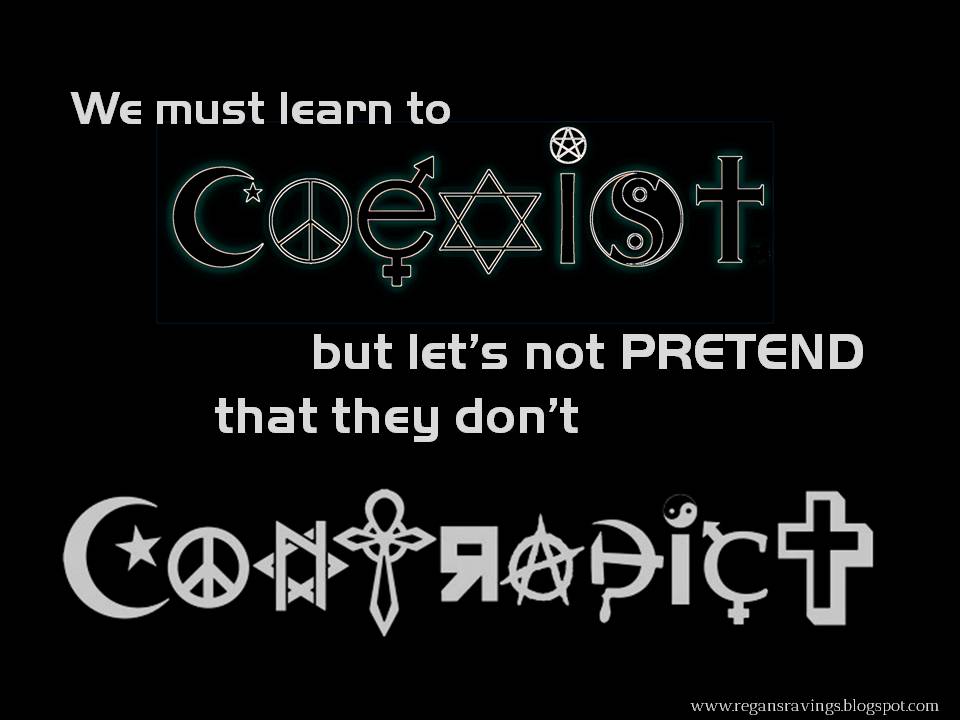 1- This view runs into logical contradictions. All the religions can be wrong. But, because of the varied truth claims, they cannot all be right. What about the exclusive claims of each religion? Take for instance the three major, monotheistic religions and their view of Jesus. In Islam, Jesus is merely a prophet. In Judaism, Jesus is a false prophet. In Christianity, Jesus is a prophet who is actually God incarnate. They cannot all possibly be true. Some might persist and say that they’re true for that person but not for another. Does this not make truth relative? No one thinks 2+2=4 is only true for them.
2-The example never really adds anything to the discussion about the relationship between religion and truth. Which part does each religion get right? What parts of the varied worldviews are true and which ones are false? The genius is in the details and there are none in the above example.
3-Are all views included? What about Satanism? Are only the monotheistic religions like Christianity, Islam and Judaism included? What about agnosticism and atheism? What about eastern religions?
4-In what ways are the blind folks and religions similar? An analogy is only strong if there are sufficient relevant similarities and a paucity of relevant dissimilarities. It would seem to me that they are quite dissimilar. Are people blind? Is religion a shot in the dark? How does the person giving the analogy have his eyes opened? What about the Christian doctrine of revelation? Are all people essentially “searching” for God? How is God like an elephant? Do the people have enough evidence to say anything meaningful concerning the nature of God? What counts as a religion? Is a religion a living organism like the blind man?
 5-The analogy is fraught with assumptions. First, the example assumes that all are equally blind. All religions are on equal footing despite the veracity of the claims made by each one. But, this is most certainly false. A religion built upon the facts of history that is logically coherent as well as existentially viable is in another ontological category than one without those features. Second, the example is one-sided. There is one person who isn’t blind. The tolerant pluralist has had his eyes opened. In the end, the pluralist is arrogant and his pluralism reduces itself to a form of exclusivism. Third, the example assumes that God has not revealed himself. For orthodox Christianity, Jesus is the final revelation of God and the sole mediator of salvation to his people. Christianity teaches that God can be known definitively and personally in Jesus Christ: “No one has ever seen God; the only God, who is at the Father’s side, he has made him known” (John 1:18); “Whoever has seen me has seen the Father” (John 14:9). Jesus Christ is the exact and final revelation of who God is. Hebrews. 1:1-3 says “Long ago, at many times and in many ways, God spoke to our fathers by the prophets, but in these last days he has spoken to us by his Son, whom he appointed the heir of all things, through whom also he created the world. He is the radiance of the glory of God and the exact imprint of his nature, and he upholds the universe by the word of his power.(Heb. 1:1-3)” Colossians 1 says that Jesus is the image of the invisible God (Col. 1:15).” The Christian rejoinder that the elephant is not silent is very important.
6-Does the analogy presuppose the reality that it is arguing for? “All religions tell a part of the truth but not the whole truth as evidence by the fact that all religions say something about the truth but none are holistically true. They’re describing truth from their perspective.” It would seem that this example is begging the question. Begging the question is a fallacy in which the premises include the claim that the conclusion is true or (directly or indirectly) assume that the conclusion is true. This sort of “reasoning” is fallacious because simply assuming that the conclusion is true (directly or indirectly) in the premises does not constitute evidence for that conclusion. Obviously, simply assuming a claim is true does not serve as evidence for that claim.






 Austin's Blog
Leave a reply to Alex Cancel reply