
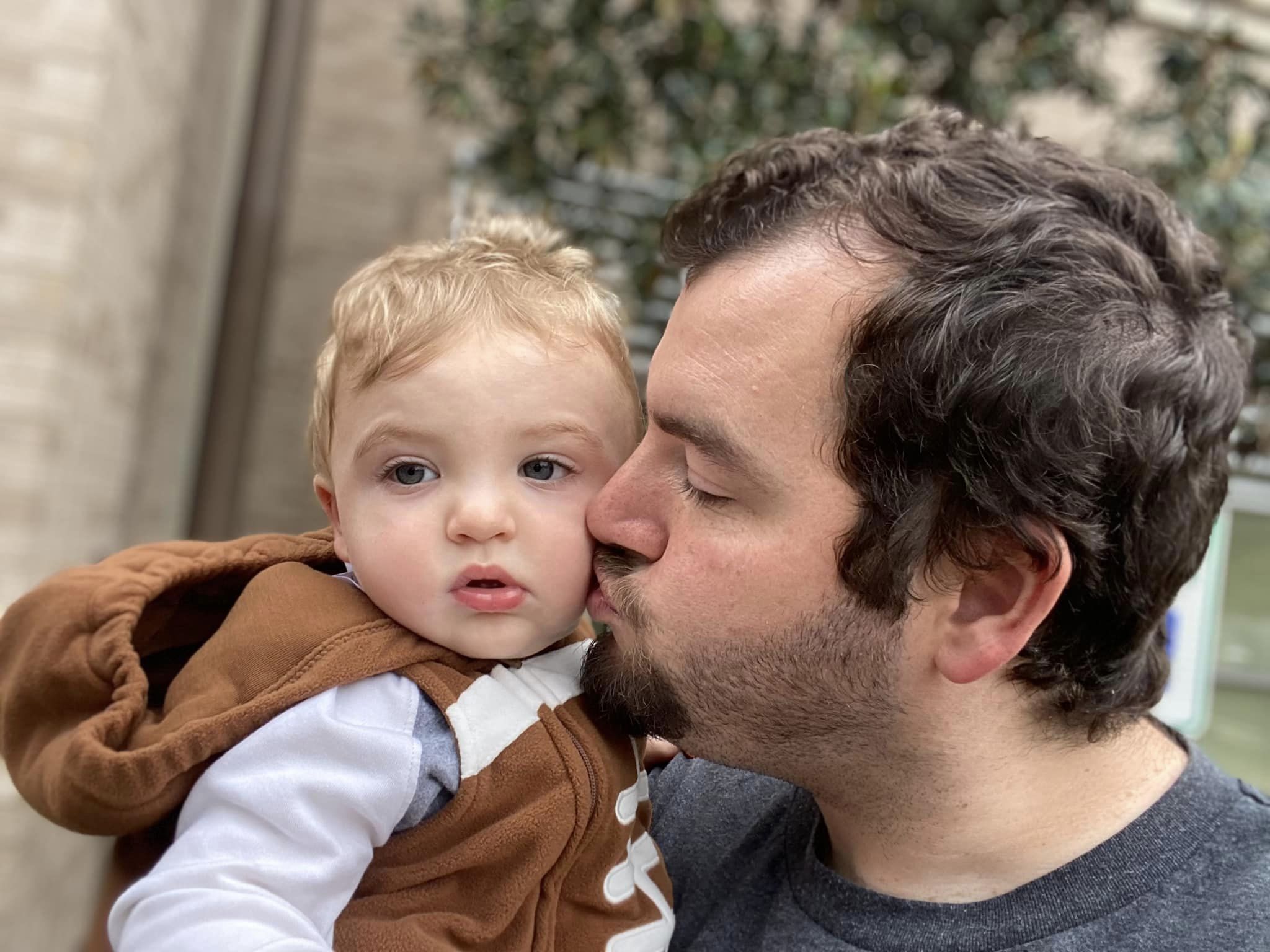
We are so often only able to trace God’s work of providence after the fact. It is usually in hindsight that we get a hunch of what the Lord is truly doing. Yet, when everything began to happen with Gabriel on January 17th, it became very apparent the Lord was teaching me a lesson in reliance and dependence. Suffering is often a call from God to trust not in the props and things of this world but instead to put our full hope and trust in Him alone.
I have never had a broken bone or surgery in my life until that dreadful day of misery, January 17th. The operation required me to go under general anesthesia. That morning, I took extra time with Gabriel and Addison because I thought, “This could somehow be the end of me. Who knows?” Gabe actually snuggled with me that morning and fell asleep on me. When we dropped him off, I held him the whole time and hugged him deeply, thinking to myself that something could happen to me. Something did happen, but not to me. Once Valerie got me on the couch and settled, she left to go pick him up. About five minutes later, that was when the call came that he was having seizures. I could not immediately go to him. I wasn’t by his side until I got Addie tended to and some brothers took me to the hospital to be with him. I was literally in a wheelchair.
I have been in this world roughly 11,600 days. How and why did it happen on that very day? It was the one day I could not carry my son into the hospital myself. Others had to carry him. I believe it happened on that one day, in part, so there would not be any temptation to fix the situation. I had to avail myself of any sense or notion of control, strength, or power. I knew and was painfully aware immediately of the truth that I was not the sovereign one. I could not stand on my own, let alone, cause my son to live! My life, and his little life, were completely in God’s hands.
After experiencing a terrible time of trouble, the Apostle Paul writes in 2 Corinthians 1:8-9, “…we do not want you to be ignorant, brothers, of the affliction we experienced in Asia. For we were so utterly burdened beyond our strength that we despaired of life itself. Indeed, we felt that we had received the sentence of death. But that was to make us rely not on ourselves but on God who raises the dead…” This sudden crisis was appointed by God so Paul would not rely on himself but on the God who raises the dead. Had Paul not already been reliant upon God? He had but he needed a new depth, a deeper experience of dependence that he had not had before. I admit that in the months prior to Gabe’s passing, I was struggling with dependence on God and feeling His presence. I was still reading, still serving, still praying because you do all that even when you don’t feel it (feelings so often come later), but I was not experiencing a nearness. Since that fateful day though, I have come to know new heights and depths of God’s presence.

N.T. Wright says of this passage, “What I am saying is that the message of the gospel, the message that the true God is the God who raises the dead, can and does go that deep; and that wherever you may be, and whenever you may hit that rock-bottom sense of despair, the gospel can reach you there too. Indeed, that is where it specializes in reaching people. It is when we are weak that we can be strong. When our strength comes to an end, that is when the life-giving wind of God starts to blow with new force. Therefore, we are not surprised if living as Christians brings us to the place where we find we are at the end of our own resources, and that we are called to rely on the God who raises the dead…Bit by bit we must open ourselves to the power of this resurrection God; and sometimes this will only happen when we find ourselves in the sudden crisis where there is nothing else that we can do.”
This is not the only thing God was up to on January 17th and the subsequent days since then. Yet, I am certain this was one of the 10,000 things He was doing. Our very strength is gone. We do not trust in the things of this world. Nothing is certain but His Word and Him alone. All else is sinking sand. Yet, in the midst of that sinking sand, we can put our hope, our strength, our very selves where it is safest—in Him. This is the Promiseland. Ted Wueste writes in Trusting God in the Wilderness, “God doesn’t leave us to fend for ourselves. We may feel alone but we aren’t. He is leading us somewhere. . . . The journey is about deepening our dependence on him. Why? Because dependence is the promised land. Hear that clearly. A life of dependence is the truest, most real hope in our lives. Our hope is in him, not some location outside of difficulty.”
“We do not know what to do, but our eyes are upon You.”



Leave a Reply